I Support the Seven Principles of the Campaign for the Future of Higher Education! You Should Too!


Friday, September 24, 2010

Rivers Test and Avon


We spent a couple of days in Southeastern England exploring the Rivers Test and Avon made famous by Izaak Walton and others. Heading on the Salisbury Plain which is also the home of Stonehenge (did a Griswold on that site), these are beautiful and very productive streams albeit very inaccessible to anglers who don't have lots of money. The difference between chalkstreams whose chemistries are affected by the limestone lithology and the freestone streams of Ireland, Wales, Scotland, and Northern England is very apparent (see the large resident brown trout in the aquatic veg - Ranunculus? - in River Test photo above). Dave will be doing some more research on the centuries long maintenance of the fisheries here, and current programs to improve water quality in the Southampton region which is home to some of the most industrialized agriculture we've seen since leaving the US.


In Paris now and looking at the canals that link the Seine and Marne Rivers, I'm thinking that it is going to be very interesting to try to make sense of how these historic yet seemingly unnecessary hydrologic features affect riverine ecology today, and how this might change in light of the EU's Water Framework Directive, Biodiversity policies, and French landscape management policies. I'm just beginning to study some French vocabulary to prepare for research to be conducted further down the road in Burgundy, Lyon, and the Pyrennees.


More later, au revoir!

Tuesday, September 14, 2010

Rivers of Scotland


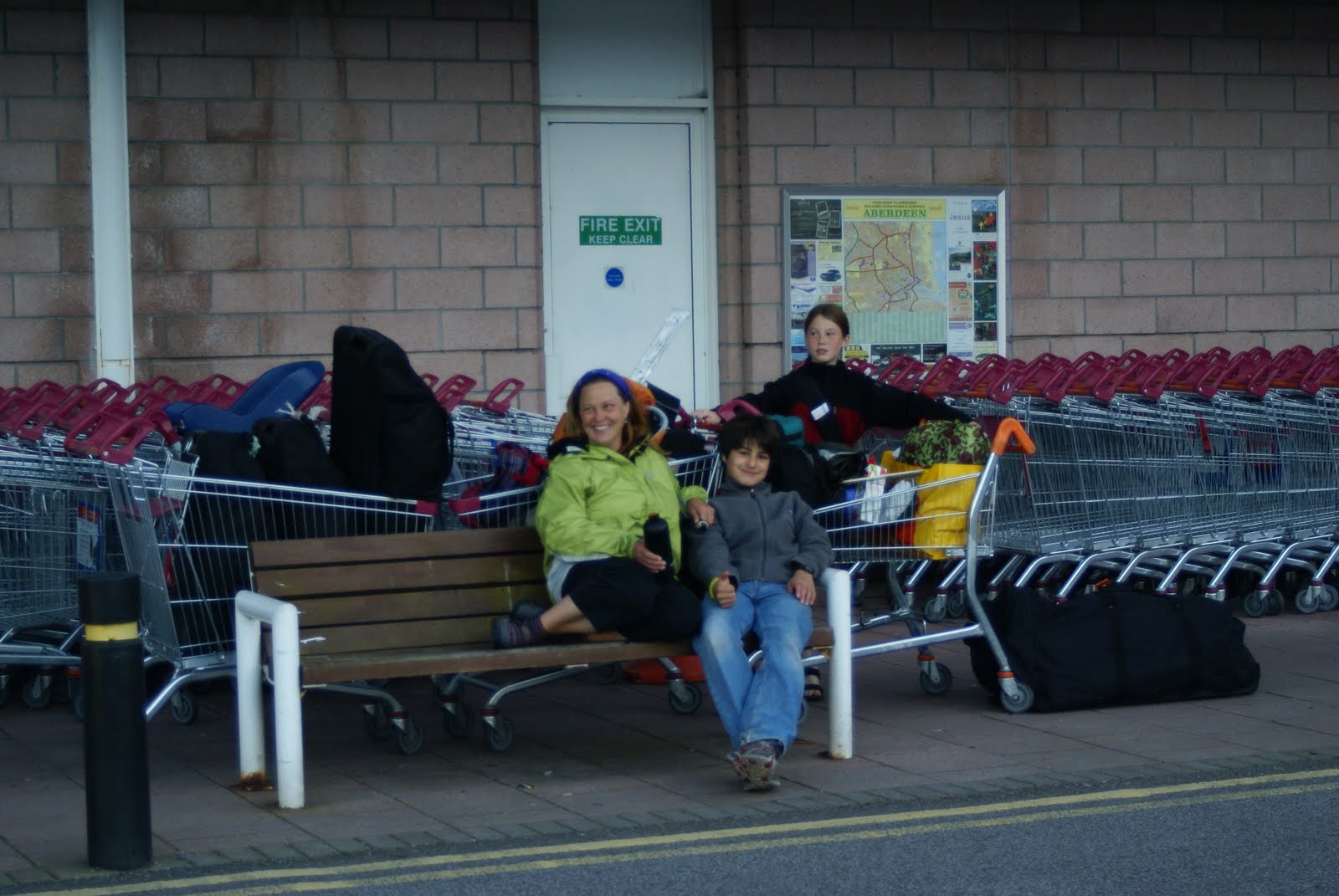
We spent some two weeks exploring Scotland - Loch Lomond NP, the Western Highlands and Glencoe, Loch Ness and Inverness, and the Cairngorms NP in which the Rivers Spey and Dee head. Travelled part of the whiskey trail, sampled some and some Haggis (good stuff w/ neeps and tatties - and an ale of course), and explored the Aberdeen area quite thoroughly including the coast south of there. Also injured our rental car by adding 1/4 tank of unleaded to it (it was supposed to have diesel only!) and now have a different one that runs on unleaded. From all that I talked to, it's a pretty common and easily remedied mistake that results from diesels dominating the roadways and both types of fuel on the same pump (you can put an unleaded pump in the diesel, but not the other way around). Should only set us back a couple of hundred pounds (about $300). Now we can fill the car and the stove fuel tanks together (figure we're getting about only 30 mpg from the stove - that's meals per gallon!). See the photo of us waiting for a cab back to our camp after the car was towed away.

Scottish salmon rivers are legendary and still hightly touted by the Scottish National Government's tourism division owing to their economic importance (probably second to golf, which of course follows oil and gas from the North Sea). The salmon still run but the trend seems to be downward over the last couple of years according to what I heard from various people. Challenges are many - agriculture, water abstraction (diversion) for hydro, whiskey distilling, and municipal uses), salmon farming in the near shore environment, predators, etc. There also appears to be a serious need for more progressive riparian managment, especially for LWD recruitment (and restoration), but the town and country planning approach employed in the UK has protected the rivers from rampant development we see in Montana.


The district salmon fishery boards (DSFBs) are the main bodies for fisheries managemment involving both riparians and angling associations in their activities (include hatchery programs, habitat work, monitoring, establishment of angling rules, etc.), but there are some noteworthy basin management programs and approaches that are underway such as the Dee Catchment Partnership's "Catchment Management Plan" (still have to finish downloading and digesting this!) and the Scottish Govt's implementation of the EU's Water Framework Directive.


The photo of the anglers' hut and the river with the bridge is from the Spey, and the other with the angler casing is on the Dee. We didn't get to fish after all given our schedule and the expense (about $60.00 US per day for even low quality pools/water - and that's a low budget rate apparently). Hope to make up for that elsewhere.


We are now in Wales again on our way south to Southampton and the legendary English chalkstreams (Rivers Avon, Test, and Itchen) to see what's going on there. Our stop in Wales was to see Cardiff, the capital city of Wales, and the Dr. Who exhibit here (they film it and Torchwood here).

Until later, Cheers!

Tuesday, August 31, 2010

North England and Scotland!


We've been rambling about for the last two weeks. We visited Snowdonia Nat'l Park in N. Wales (and importantly Paul Morgan's Coch Y Bonddu Bookstore in Macynlleth, Wales - the very best bookstore for angling ever, anywhere! - see link on this page!) then the Lake District Nat'l Park in Cumbria, then Hadrian's Wall in Northumbria (& Northumberland NP), Loch Lomond NP in Scotland, the Western Highlands (stunning mountains!), around Loch Ness and Inverness to the River Spey in the Speyside District of NE Scotland (Whew!).

Besides eating the scenery, and an excellent meal at the Battlestead Inn at Wark, England, we've had some excellent meals of our own all prepared on the MSR Whisperlite International (on high octane unleaded!). Local lamb and beef, seafood chowder, and even several rounds of wild chantrelle mushrooms and puffballs that we've found here and there. Think we'll begin working on a cookbook too!

Now in Aberdeen, on the River Dee, we have a chance to get back to work and blogging, etc. Will also post some pictures to the Picasa site. The image posted here is of a small lake in Snowdonia with association fishing that we found on our way to Eddie I's Caernaforn Castle (built to subdue the Welsh!).

We've seen some salmon fishing here in Scotland, and it turns out that the fishery on the River Tyne in Northumbria is recovering as well due to the decline of heavy manufacturing and shipbuilding in Newcastle Upon Tyne. Met some really nice folks around Hexham and Bellingham England who put us on the trail of fish squeezers in Edinburgh, our next destination in a week or so. Until then I'm going to visit with Geographer colleague Antonio Ioris at University of Aberdeen, and his colleagues, and try to arrange for some salmon fishing on the Dee! Might even bump into the Queen as the fishing has just turned on here in N. Scotland, and her summer palace is just up the road!


So, until later, here is a pic from the recent travels. Cheers!

Monday, August 16, 2010

Leaving Aberystwyth


We've spent the last two weeks in Aberystwyth and have done some research, sight seeing, and fishing (these are all inter-related of course!). Dave experienced wonderful hospitality on the part of Michael Woods (Professor and Head of Geography at Aberytstwyth University), Chris Bear (Lecturer at AU), Dai Ricketts (of the Llanilar Angling Association, Welsh Salmon and Sea Trout Assoc., and Captain of the Welsh National Angling Team), and Mark Sedgewick ( of the Aberystwyth Angling Association). Many, many thanks to Chris, Dai, and Mark for the loads of valuable information, and for the coffee, the field trip (including time on the river), and the pint of best bitter (all respectively!).

Sewin (sea trout) and salmon angling in Wales is stronger than ever and the levels of local organization and attempts to influence national policy are increasing, and much of this is in response to declining returns of fish and increased activity of other river users. These are problems that are similar to Ireland, and in the US. It seems that a broader study of the status of anadromous fishes would be in order (a meta-analysis), but will have to save that for later and perhaps with the help of others! The pic on the top is of the Boyz about to begin fishing for Sewin on the Ystwyth last night. We fished from Dusk to about 11 pm (in the dark!).

The pic on the bottom is of the Environment Agency, Wales, flood awareness campaign promotion. We visited with a couple of their staff on the street today and will later access the flood zone maps for Wales and England to compare with those produced by FEMA in the US.

We're off to North Wales, the Lakes District, and Scotland next in the Silver Bullet (our Peugot 5008)! Will update you as we can. Cheers!

Saturday, August 7, 2010

Fishguard Wales


We arrived in Fishguard, Wales (Abergwuan is the adjacent older Welsh settlement across the River Gwuan - Aber is Welsh for river mouth) on August 2nd. We had a 4.5 hour bus ride, a milk run, from Cork to Rosslare Harbor where we caught a Stena Line express ferry (a catamaran fast craft) across the Irish Sea to Wales. With the kind help of Tony the taximan we were able to get cash (British sterling) and some groceries to tide us through the night and next morning, then he dropped us at Fishguard Bay Caravan Park where we had a tent pitch reserved. The site is stunning (as the photo tells) being situated on the edge of the cliffs that run the length of the Pembrokeshire National Park coastline. This morning we hiked 3 miles into Fishguard along the coast trail, had an ale (and Cokes) at the Royal Oak (now a pub) where the treaty marking the end of hostilities between Napoleonic naval forces and the British was signed in 1797 (this was the last actual invasion of Great Britain).

The hike showed that the planning system in the UK does far more to protect the rural landscape than is the case in Ireland - or so it seems. The Shive will be learning more about that shortly. After a day of trip planning tomorrow, we're likely off to Cardigan and then Aberystwyth some time down the road. We have some 50more days in the UK, so we're not in a hurry!

The Shive also has to make some contacts with angling clubs to learn about fisheries management and the like here. Two days before our departure from Ireland he learned much about the Irish situation for freshwater gamefish (espec. Atlantic salmon) management and conservation from Bob Seward, Secretary of both the Salmon and Sea Trout Recreational Anglers of Ireland and the Angler's Council of Ireland - more on this later.

Until then, cheers (as they say here) and thanks a million (as said in Ireland) for following our adventure!

Friday, July 23, 2010


Cork, Ireland, is a fascinating, historic, and incredibly friendly city. From early Celtic roots, verified by Og(h)am inscriptions on stones found throughout the region and now displayed in the Stone Corridor in Aula Maxima at the beautiful University College Cork, the narrow lanes of the 9th century Viking settlement that emerged on the island in the River Lee, the Victorian historic structures, to the modern shops that are nestled in between all of the rest, it is an eclectic and intriguing place! No wonder it is on Lonely Planet's short list (10 best places to visit).
The people of Cork are very friendly. Numerous times we've been offered assistance when our confusion over location and direction became apparent (new place, meandering streets, cloudy skies, no compass!). And many thanks to Brendan O'Sullivan who directs the Planning and Sustainable Development Program at University College Cork for the informal walking tour and engaging discussion over planning issues, approaches, and problems!
The planning context for Cork is influenced by a national framework (the National Spatial Strategy) that gives responsibility for spatial planning to regions, and then to the counties and five major cities, then to smaller cities (all local government plans must conform to the statutory regional planning guidelines). Planning for future growth and dealing with the inevitability of sprawl (when the ability of urban places to continue to grow when constrained by existing densities, the historic preservation imperative, and greenbelts) are major challenges here as they are in so many other places.
If and when you come here, do plan to spend a week or more as there is so much to take in. The Vision Centre, UCC, St. Finnbarre's Cathedral, the City Centre, the English Market with delicious fresh local food for your kitchen - these are just some of the major attractions!

Sunday, July 11, 2010

More on Aquatic Invasive Species


I just had to post this - it was waiting in OneNote for me to do this. We've been in Oregon for the last weekand a half visiting with family and friends before we leave for Ireland on July 17th. After leaving Umatilla we travelled through the Bend-Redmond area on Hwy. 97 before heading up Century Drive (aka Cascade High Lakes Hwy.). Wow has Bend grown over the last 15 years since Gret and I last visited during winter ski trips. 80+ thousand now (larger than sweet little Missoula) with a renewed downtown, a lot of roundabouts to accommodate increased traffic volumes from new subdivisions on the way up Century Drive, and the new Hwy 97 throughpass.

Given the Idaho Aquatic Invasive Species program I mentioned in the last post, we inquired about one in OR and learned that there is a fledgling program just being implemented. Signage is up at boat launches, and permits are required for craft 10 ft or longer (these are good for a year and transferable). It will be interesting to see how effective the program will be once fully implemented - I'll research it more further to better understand what its parameters are. In the meantime, here is a pic of a boat/car/RV washing station at the Port of Siuslaw, near Old Town Florence, where we spent a nice night camping before driving up the coast to Newport (nice to be back on the Oregon coast - the most scenic in the land!).