I Support the Seven Principles of the Campaign for the Future of Higher Education! You Should Too!


Wednesday, August 1, 2012

Aliza Keddem (1930-2012)

With great sadness I am reporting that my mother, Aliza Mizrachi Keddem, passed away on July 19, 2012.  My brother Dan, his wife Rachel, my wife Gretchen, and myself are tending to the affairs that arise in such events, including making arrangements for a memorial/celebration gathering in Aliza's honor.  The celebration is on August 11, 2012, at 1 pm, in the Old Library at Marylhurst University in Lake Oswego, Oregon.  For driving directions, please visit http://www.marylhurst.edu/about-marylhurst/contact/driving-directions.html. If you knew Aliza, and would like to join others in celebrating her life, please join us. I'm now posting an extended version of the obituary Dan and I wrote that will be published in the Sunday (8/5/12) edition of the Oregonian.

  Aliza Mizrachi Keddem (born April 29, 1930), a Portland resident, long-time educator, and social activist, passed away in her home on July 19, 2012.
  Aliza was born in Jerusalem to Sarina Laniado-Perera and Isaac Mizrachi, the second of their four daughters who include Rachel, Adina, and Vicky (Nizhia). As a teenager, Aliza was active in the Gadna – the Hagannah’s youth corps. Later in New York City she helped obtain needed supplies for pre-independent Israel under the direction of Teddy Kollek, who later became Jerusalem's Mayor. Following Israel's independence, she worked in the Israeli Consulate in New York City. She later worked at the Israeli Embassy in Washington D.C.
  Aliza attended Columbia University in New York, and graduated in 1957 with a B.S. in Mathematics. In New York, she met and married Stan Shively, and they later had two sons David and Daniel. During her years with Stan, they lived in New York City, Pittsburgh Pennsylvania, Santa Monica California, Norman Oklahoma, Corvallis Oregon, and Hong Kong. She taught mathematics at Midland Park High School in New Jersey, and assisted in social sciences research at Columbia University, the University of Pittsburgh, and the Chinese University of Hong Kong.
  Aliza commenced her graduate studies at the University of Oregon in 1973. She earned a M.A. in Political Science in 1975, and a Ph.D. in Sociology in 1984. Her doctoral research was on "The Integration of Wives into Wage-work and the Working-class' Struggle to Maintain
Its Standard of Living." She next moved to Portland, Oregon, where she taught mathematics at Roosevelt High School from 1984 to 2000.
  Before her retirement from Portland Public Schools, Aliza began teaching night courses in Sociology at Marylhurst University. Her course subjects included critical postmodern theory, gender, family, and inequality. She continued teaching at Marylhurst until last spring. Her “third career” was her most rewarding, and she reveled in engaging her students in thought, analysis, and discussion.
Aliza will be long remembered by family and friends for her strong determination and passion for social justice and equality, the environment, and progressive politics. She is survived by her son David and his children Rio and Ari; her son Dan and his children Matt, Amber, Travis, Ashley, and Matthew; and her sisters Rachel, Adina, and Vicky.

Tuesday, November 8, 2011

Why Can't Ponyboy Get a College Degree?

Big Ups to Ohio for the rejection of a state law that limits the right of public sector employees to engage in collective bargaining (see http://www.guardian.co.uk/world/2011/nov/09/ohio-election-results-union-curbs?newsfeed=true)!!!

To the topic for today:

Ponyboy Curtis is a Greaser, and the protagonist of S.E. Hinton's novel The Outsiders.  My son Rio is playing the role of Johnny in Missoula's Hellgate High School's stage adaptation of the story, and while Johnny dies (as a result of a heroic action saving schoolchildren from burning to death inside an abandoned church he and Ponyboy had taken refuge in after Johnny killed a Soc in self defense), Ponyboy it seems will go on to transcend his lower class existence by drawing on his inherent sensitivities and literary interests to attend college and have social mobility.

The story (sorry, but see http://en.wikipedia.org/wiki/The_Outsiders_%28novel%29 for a synopsis) is about class warfare between adolescents or young adults. In the late 1960s, when Ponyboy would have matriculated to college, the American public universities were just entering their glory years as highly accessible and affordable institutions of higher education, but today they have begun to resemble and function more like exclusive private schools that even the Soc's of Tulsa would have had difficulty gaining admission to. How can this happen?

This story is as much about class warfare as The Outsiders, and is rooted in the structural and fiscal transformation of the American economy and politics that have occurred since the ascendancy of neoliberal policies beginning in 1980.  The fact is that U.S. public universities are choosing to attempt to improve their ratings (nebulous ones from US News, ABC News, and Forbes) by diverting what was previously need-based financial aid from those who needed it to those who "merit" it based on SAT and ACT scores and their high school resumes. Why?  These ratings help to boost the recruitment of out-of-state students who will pay higher levels of tuition and help, in a large way, to sustain the economic viability of the university in an era where public spending for higher education has been steadily decreasing because of the neoliberal agenda that promotes decreased taxation on the 1% and state responsibility for higher ed funding.  Enter the Tea Party.  So Ponyboy has been squeezed out, as have been countless young people of the working and lower middle classes and people of color.  The statistics show that such groups produce a lower proportion of potential students who have the required level of merit as the middle middle and upper middle classes, and the 1% of course. And Ponyboy is less likely than ever to complete his education - so he will have a huge debt and no degree and a lower wage too!

These facts are well documented in two fine books, The Future of Higher Education by Dan Clawson and Max Page of UMASS Boston, and Saving State U: Why We Must Fix Public Higher Education by Nancy Folbre of UMASS Amherst (full references below).  The are highly accessible (digestible) and highly affordable ($10 and $15, respectively)!  It is notable that both books were written by scholars in the UMASS system, which has undergone considerable neoliberal stress in the last few years and which has spawned PHENOM (Public Higher Education Network of Massachusetts).  I highly recommend both books to anyone and everyone with an interest in higher education (an economic necessity for individuals and the nation at large) including students, parents,grandparents, guardians, teachers, professors, contingent faculty, administrators, and legislators. This is as essential reading today as "_____ for Dummies."  Check them out and vote to support higher education!

Clawson, Dan, and max Page.  2011.  The Future of Higher Education.  New York: Routledge.

Folbre, Nancy.  2010.  Saving State U: Why We Must Fix Public Higher Education. New York: The New Press.

Sunday, November 6, 2011

The Second National Conference of the CFHE

I'm in Boston where the 2nd annual meeting of the Campaign for the Future of Higher Ed just concluded.  I'd post a picture or two from the event, but they're not out yet!  Stay tuned.

I wasn't able to be involved with the Campaign last year because I was traveling, but am happy that I can be now.  This national organization (see the link at right and the Seven Principles above) is tackling the critical issues that impact America's ability to deliver quality public higher education to the people who need and want this. The facts are:

1) People of color and those who don't have much in their pockets are being squeezed out of colleges;
2) Most of the 99 percent are going into deep debt paying for a basic college education;
3) Established faculty are being squeezed out by temporary workers (contingent faculty), contingent faculty are being denied the right to stable employment, salaries that afford a very basic quality of life, and essentially have no academic freedom;
4) The quality of higher education is under serious assault;
5) Big business is staging a massive takeover of the American system and institutions of higher ed.

Enough Already!

If you are a student, a parent or guardian, or a college teacher, you need to learn more about these issues and what you can do about them. We can't be complacent any longer!  This blog will provide information, resources, and connections to organizations that are tackling these issues community by community, state by state, and nationally.

I'm a professor because I believe in the power and value of education - I know you do too! Support your local college or University; Mel Brooks would.

Wednesday, July 6, 2011

Back Home in Montana


Greetings All,

I’ve been negligent in writing to let you know of my activities recently, and to let you know of upcoming plans for my research.

The family and I returned from our overseas sabbatical travels in mid-April. Our destinations included Ireland, Wales, Scotland, England, France, Spain, Israel, Beijing, Tokyo, and New Zealand. The travels and research went very well! We camped the majority of the time except for about 2 months out of 9 during the winter (in Spain, Israel, Beijing, and Tokyo). I tried to keep up with this blog most of the trip, though updating it frequently was a challenge due to time and technology constraints. I hope to get back to it as I wade back into the writing component of the research.

After arriving back in the US, we spent a week in Seattle at the annual conference of the Association of American Geographers. I gave a paper there on the sabbatical research, saw some old friends, and made a couple of new ones too. Then we spent a month in Oregon visiting family, I worked on research, Rio on his online high school courses, Ari on his homeschool projects, and Gret for her sister on her organic farm near Dallas, OR. I returned to Montana in mid-May to attend a faculty workshop on integrating sustainability into the university’s curriculum, did some committee work with students, and spent a week or so in the field collecting more data for the research project [Pics are of Upsata Lake in the Blackfoot Valley, Holter Dam, and the mighty "Mo" (Missouri River) below Holter - all in mid-to-late May].

I moved back into our house on June 1, and Gret and the boys returned on the 8th . We’re now fully ensconced back in the house, have the dogs and cat back, are back at work, and missing the tents! Western Montana has been experiencing high river discharges and floods ever since I returned, and it will still be another couple of weeks until the rivers are safe to float and fish. Just yesterday a woman drowned on the Blackfoot River – one of many such incidents this summer. The high waters are a result of the best winter snows since 1996-97, I’ve been told – there is still snow at moderate elevations in the mountains around town and across the state!

It is good to be back home and into the routine again, and we look forward to being able to get back outside to some outdoor activities soon. Western Montana is simply beautiful, and should you get a chance to come and see for yourself – take it! And let us know you’re coming of course.

Well, if I visited with you in connection with the research project or academics in general during our travels, many thanks for your time and hospitality! I will be communicating further with you in the very near future as I work on fully developing the research project’s case studies. For the fellow travelers we spent time with during the trip – we hope you are all well and enjoying whatever place you are in at the moment. We hope you stay in touch and we will try to do the same. You can always find me at the University of Montana’s Department of Geography (http://www.cas.umt.edu/geography/).

So, until later, Peace All!

Monday, May 2, 2011

Back in the PNW!


Hi Folks,


We've been back in the Pacific Northwest for about 3 weeks now and enjoying our first Oregon Spring in many, many years. I attended the annual meeting of the Association of American Geographers in Seattle from April 12-16, where I gave a paper on the sabbatical research, visited with old friends, colleagues, and students, and took part in a great boat tour of the Port of Seattle (see pic above) organized by my former student, Michael Ewald. We toured the dockyards and up the Duwammish River mouth in which most of the port facilities are located to see several restoration projects - nice stuff!


Following our return to Oregon, and in between visits with family up and down the verdant Willamette Valley, I joined my brother Dan with several of his colleagues for a float on the McKenzie River. The crew included Tom Wolf and Karl Mueller from Oregon Trout Unlimited, Jim Capurso who is the Region 1 Fisheries Bioloist for the US Forest Service, and Jason Dunham of Freshwaters Illustrated - see the link at right for his organization that promotes aquatic awareness. The river was high but clear and cold on the nicest Spring day to that date, and while the fishing was slow the talk of conservation, food, and comraderie was second to none. Oregon Trout Unlimited, and the McKenzie-Middle Fork Willamette Chapter in particular, are championing the restoration of native McKenzie redsides (rainbow trout) to the lower river that Dan and I enjoyed so much years ago. The continued presence of these fish suffers from a put and take hatchery trout fishery that operates there today, and their restoration is imperative for the river and the green image of Eugene. I'll be learning more about this in the next two weeks and will report here and in the book later.


I'm returning to the mountains in mid-May to complete the fieldwork - have some fishing to catch up on too!


Cheers for now,


The Shive


Sunday, March 27, 2011

A Wet Weekend


Our weekend in the Rotarua area was WET (see our blue-tarp shelter off the back of the car - the envy of backpackers all over NZ). We stopped to see the Ohau Channel diversion wall (see pics) in the Kaituna Arm of Lake Rotoiti that diverts warmer water from Lake Rotarua into the Kaituna Stream outlet of Rotoiti thus protecting Rotoiti from degraded water quality. This has, according to Matt Osborne of Fish and Game (Bay of Plenty), and Dr. Brendan Hicks at the University of Waikato, worked to protect the Rotoiti from the effects of eutrophication that have plagued Lake Rotarua.

Next we were off to the Lake Tarawera outlet to camp at a Department of Conservation campground there. This is an important spawning and rearing area for Tarawera's rainbow trout, and there is a 150 m spawning sanctuary there at the outlet (see pic - the large rainbows spawn at the lake outlet and the juveniles move upstream into the lake itself). Gret and Ari took a hike to Tarawera Falls some 3.5 km below camp, and Rio and Dave hung out in camp under the blue tarp. We followed up our visit to Tarawera at Kawerau's public pool (free) which features a natural geothermally heated hot pool for soaking. Nice!


Now, some 200 km away near Taumarunui at another DOC campsite, we're on the Forgotten World Highway on the Whanganui River (muddy after the rains) and catching up on work at the public library which features the Aotearoa People’s Network Kaharoa that provides free internet and broadband wireless access to the public as a part of the NZ Digital Libraries project. Rio is wrapping up his studies before Spring Break begins for him in a week, and we have sunny skies again! Until later, Cheers All!

Thursday, March 17, 2011

Sad News


Unfortunately Little O was put down. He was evaluated by a Vet who determined that he would probably die or require too much intervention. It is sad. We're pretty pissed off by the whole thing (his circumstances, the decision, the lousy attitude of the woman working the desk at the Taupo Pound).

Anyway, we did fish the Picket Fence on Lake Taupo, and the Waitahunai River, but with no luck. We got to see the whare (Maori for "house") at Windsor Lodge that holds many artifacts that help to document the social history of angling from the lodge and in Waitahunai. Rich at the lodge involved with the Waitahunai Angler's Improvement Association (an old club in the area) and in a flyfishing education program for kids. Neat stuff.

On leaving Taupo we saw Hukka Falls on the Waikato River that drains Lake Taupo (impressive - see pic), and a geothermal-electric project nearby (first in NZ and quite the engineering feat even if it is a blight on the landscape - also see pic).

Dave gave a talk at the University of Waikato, and now we're staying near Rotarua and doing more research, fishing, and visiting with a nice couple from Germany/Switzerland that we met in Picton before we left the South Island.
We're off to parts still unexplored for the next week or two before we return to Auckland for our 13 hour flight back to LA, then hops to SF and Portland (on April 9). May not post to the blog for awhile unless some cool sights seen and cool things happen.
Cheers all!

Tuesday, March 15, 2011

"Little O"

We went to fish the "Big O" yesterday afternoon, Lake Otamangakau, which is well known as New Zealand's trophy rainbow trout fishery. Dave was pretty jazzed as he'd just finished visiting with Dr. Michel Dedual, Fishery Scientist for the Department of Conservation's Taupo Fishery Area, who showed him fish data and fish pictures, and even told him where to fish! This on the heels of years of stories from friend Chad Newman who fished the Big O with good success on his visit to NZ in earlier days.

We got to the lake and began to check out an area recommended by Michel, this requiring some clever and careful driving with our low clearance Ford Mondeo wagon. Gret had her eyes closed for much of this - Dave had to peek once in a while since he was driving. After getting into and out of one potential area from which to launch our flyfishing offensive, we tried another little 2 track that we hoped would take us to a better spot. We reached a fork of sorts, in the narrow track, and Ari noted from the back seat - "Hey, a puppy!"

Dave stopped and we all looked at the pup - both he and Gretchen knew that the fishing wasn't going to happen that afternoon. The pup was sitting near a bush, with one eyelid stuck shut, and as Dave got out and approached it, the pup came over to greet him. A 6 or so week old white bull terrier or some such breed, the poor little chap was emaciated. He'd been sitting on a box on which was his dead litter-mate; both pups had been abandoned there in the bush and had been there for a week probably.

We put the pup in a box and drove the half-hour back to Turangi on the south shore of Lake Taupo. The Police station was closed, but there was a phone at the entrance that connects with dispatch, so an officer was dispatched to meet us there at the station and take the pup from us to deliver to the SPCA office up the lake at Taupo the next day. Dave asked if we could call to check on the pup's status, and noted that his name is "Little O." We will call or check in on him soon to let you know how he is.

Cheers!

Sunday, March 13, 2011

Anglers' Paradise


We're in the Taupo area, staying at Rich and Sandy's Windsor Lodge in Waitahanui, near the mouth of the Waitahanui River which is the site of Lake Taupo's famous picket fence (see the pic!). We have yet to fish, but Rich and Sandy have been helping us make contacts with key Department of Conservation staff (DOC manages the Taupo District's fisheries - all others in NZ are managed by Regional Fish and Game NZ Councils - more on this below), a local guide, and anglers.

Zane Grey probably first described New Zealand as an "Angler's Paradise," at least in print, and this is certainly true of the entire country with it's popular bluewater, near-shore, and freshwater fisheries. Because most anglers aren't as wealthy and energetic as Grey and now often focus on a particular type of fishing, Dave would revise his title to "Anglers' Paradise." All of the fisheries are different than when he visited - recent gossip and writings indicate that the offshore bluewater fishery for marlin and other large marine gamefish has deteriorated, that the trout in Lake Taupo are smaller and less plentiful than they once were, etc., etc. There are numerous reasons for these turns of events, no doubt, but NZ still is Anglers' Paradise!

Lake Taupo is one of New Zealand's most important draws for domestic and international anglers. It is being managed for wild fish (all salmonids in NZ are introduced species), and a quality fishery. The assumption on the part of DOC is that the health of the fishery is a reflection of the overall health of the Taupo Basin - the assumption that underlies the research Dave is conducting. And what a piscatorial landscape this area displays! The signage for each community along Highway 1 along the east side of the lake features fish (see the pic for Turangi), as do many of the businesses (also an angling theme - especially in Turangi). There is the National Trout Centre just south of Turangi on the Tongariro River (when we tried to visit on Friday 3/11/11 the Centre was celebrating the opening of an expanded aquarium with many local dignitaries and benefactors attending) which has an important historic and current educational mission to educate Kiwis and visitors alike about the importance of clean water and healthy aquatic ecosystems. See the pic above of the boys sampling the fish at the Centre's trout pond!
Lastly, more about the DOC, the Regional Fish and Game NZ Councils, and fisheries management. Both the DOC and the Regional F&G NZ Councils (as well as the National F&G NZ Council) are funded entirely by license fees. In the case of the Regional F&G NZ Councils, twelve councillors are elected by license holders who have ticked the appropriate box on their license forms when these are purchased. They must specify a particular region that they wish to be able to serve as a part of the electorate, but they may fish anywhere in NZ (freshwaters only, outside of the Taupo Basin - marine fishing does not require a license!) with their F&G NZ license. The Regional F&G NZ Councils then appoint from amongst their ranks one representative who will serve at the National Council level. Additionally, councils at both levels are served by professional staffs (with heavier science emphasis at the regional level and heavier policy emphasis at the national level). Thus, Fish & Game NZ is essentially a self-financed democratic institution.

Well, it's time to leave the virtual world in favor of the real one, with real fish in it, so Cheers to all of you again. We plan on fishing the Waitahunai and at the picket fence yet - will have a big fish story for you later we hope.

Thursday, February 24, 2011

The Earthquake in Christchurch


Now that we have a little time, we should give you more info on the earthquake in Christchurch, NZ. We were going to go there on Tuesday when the quake hit, but Rio had President’s day off so on Monday we instead stayed two hours south of the city and spent time on a beach and checking out the salmon fishery there. If we hadn’t, we were going to be in Christchurch’s downtown, at a library or wherever there was wifi, when the quake happened. We’re and so glad we weren't as this was the zone that was worst hit. The quake had a magnitude of 6.3 quake and an epicenter some 11 km from downtown. It was just 5 km deep we heard. Many multistory buildings downtown collapsed, and as of this morning there are 113 fatalities and still 200 persons missing. The quake was worse in most ways than those that struck the city in September and December as no lives were lost previously in those events, and much more damage occurred this time. For new from Christchurch’s newspaper, The Press, you can follow this link: http://www.stuff.co.nz/the-press/. The quake was really a bad one for this community- we'd already seen the assessments and repairs from the last batch of shakes. The town was still a mess when we saw it in late January, and I know it's much worse now. It is clear that the city, and New Zealand in general, is going to have to plan and build much more conservatively in the future.

We were coming into town at 1 pm when it struck, but didn't know until 2 pm after trying to find a bite for lunch and found shops closed. Kids were out of school standing on the streets, and traffic was snarled. We turned on radio and got the news and decided to divert around town and go north to get safe and out of everyone's way. We hit a grocery store at a city 20 minutes to the north before literally heading for the hills, and it was buzzing. On Wednesday we visited with Don and Jenny, friends of the Shively family, in Pegasus (just north of Christchurch). They treated us to a tour of their brand new and growing community (Pegasus is a new planned community), and a wonderful Kiwi evening tea. While there we felt a couple of aftershocks and watched Don’s seismometer (a half full glass of water on the entertainment center) shake. Unfortunately, Dave’s research contacts have been affected by the quake and he will connect with people again after some time when agency offices have reopened.

We’re now on the west coast of the South Island after travelling through Arthur's Pass National Park, and catching up on school (Rio and Ari) and work (Dave). We’ll go to see the snouts of the Fox and Franz Josef Glaciers tomorrow – we couldn’t not go as these, along with the Tasman Glacier that we already visited in Mt. Cook-Aoraki National Park, are the most accessible glaciers in the world (and large and still quite dynamic). We do wish we could go back to the Tasman Glacier because we heard from Don that a large piece of the snout/toe had calved off into the meltwater lake below it. In a few days we’ll head back north to the Marlborough region, catch the ferry back to the North Island on March 5th, then Dave will visit and give talks at Massey University in Palmerston North on March 7th and 9th. After that we plan to spend time at Lake Taupo, one of the world’s noted rainbow trout fisheries, then we go back to Hamilton where Dave will visit and give another talk at the University of Waikato (March 18th).

We hope that folks in Christchurch can get their lives back in order soon. That will be a challenge though. We're safe and will stay that way. Thanks to those who called and wrote! Love to you all, the Shivegaards.

Monday, February 7, 2011

The Mighty Mataura


We've spent some time in and around the Mataura River basin for the last five days, fishing and interviewing anglers. The town of Gore calls itself "The World Capital of Brown Trout Fishing" due to the incredible fisheries here, and ranks high on the list of piscatorial landscapes of the world (see the pic of the giant brown trout above!). After visiting Stu's World Famous Flyshop in Athol, we did some fishing on the nearby Oreti and the middle Mataura and Wakaia (Gret had some success!), we came to Gore because of iminent inclement weather and our needs for internet for school and work. After about 75 mm of precip on Sunday night (we were in our tents!), the Mataura has risen to flood stage (see pic above). Its browns are going to be even browner!

Fisheries management here in New Zealand, outside of Lake Taupo on the North Island, is the responsibility of Fish and Game Councils that operate at the regional and national levels. These councils are comprised of members elected by hunting and/or fishing license holders, and is autonomous in regard to the national government. All of its revenue comes from license fees, and it sets regulations, reviews and comments on consents for development (hydroprojects, water abstractions, dairy operations, urban projects, etc.) as well as working to protect threatened rivers and waters with conservation orders. I'm still learning about the details of these activities, but the system seems to be quite unique in that it is run by the sporting stakeholders themselves. Still, there seems to be a lot of room for politics!

We will try the Mataura and some of its neighboring rivers and tributaries after they drop back into fishable shape (we are still in search of more wading boots to replace those we sent home because their felt soles are banned by the government for fear of new aquatic invasive species introductions), but until then we plan to visit Invercargill and Milford Sound. Will report further when the opportunity presents itself.

Until later, Cheers!

Friday, January 21, 2011

Japan to New Zealand


This is a long one - sorry folks!


Two weeks we spent in Japan, solely in the Tokyo area, and me and Rio with colds that we picked up in China. They came on just after clearing Narita Airport's quantine area at which your surface temperature is measured with a thermal scanner as you pass through a certain gate. Saw as many or more people on the streets wearing surgical masks to prevent infection as in China - Gretchen observed that they are really only effective for an hour or two - good point to keep in mind! Now, miles away from any international airport, we see no masks.


Our time in Tokyo was spent in a hostel, JGH Hostel in fact, a real rabbit warren but really nice owners and managers. We were all in bunks in a room of 2 m length, 1 m wide, and 2.5 m high! See the picture above. After a week at JGH we went out to the countryside near Narita Airport to stay with Takashi Yamamoto (Yama) at his Narita Airport Hostel. Yama is a great guy full of knowledge about Japan and other countries to which he has travelled. For any travellers visiting the Tokyo area, this is a good place to stay with pretty easy bus and train service to Narita and Tokyo. Yama will lend you bicycles for tours in the countryside around his hostel. We visited the buddhist shrine in Narita, which was still very busy with New Year's events (prayers and offerings for a new year of good luck and fortune), and the beach and coast (see pic above).


Now in New Zealand for three weeks almost now, we're in Twizel (pronounced with a hard I) just in the shadow of the Southern Alps and Aoraki/Mt. Cook. We found some more free camping and travelled up to Aoraki-Mt. Cook National Park to view the Tasman Glacier's snout. It was very cool - had been producing icebergs that were floating in the meltwater lake (Tasman) between the snout and the terminal moraine. Glacial landforms throughout this entire area are incredible.


Christchurch is a pretty neat city. It's still in earthquake recovery mode (the big quake - 7.1 - occurred last September) with many older structures, especially churches, surrounded by scaffolding and under repair. While there we got equipped for the rest of our camping and travels, and made an excellent contact for my research which we will follow up on when we return in a couple of weeks.


On our way to the South Island we had a great crossing of Coook Strait - with Hectors Dolphins, salmon farms, and crazy-bad logging seen in the Queen Charlotte Sound. We camped a couple of nights for free at a Department of Conservation site on Robin Hood Bay, then off through the rest of the awesome Marlborough region and down to Christchurch.

Our North Island activities after leaving Auckland where we bought a car in under 2 days (a 96 Ford Mondeo Wagon w/ just over 100,000 km for about $1,800 US) included 5 days on the Coromandel Peninsula not far from Aukland. Beautiful beaches, nice camping spot or two, and severe sunburn - really have to watch those UVs in NZ - they'll get you fast. We then spent 5 days in Hamilton visiting at the University of Waikato and the public library where Rio completed his final exams for his online courses. An old acquaintance of Dan's (Shively) from Oregon State University's Dept. of Fisheries and Wildlife, Dr. Brendan Hicks, was kind enough to help bring me more up to speed on the history and structure of New Zealand's trout management approach.


Well, librarian says it's time to go, so more later mates!

Tuesday, December 28, 2010

Israel and Beijing


We spent sixteen days in Israel after leaving Europe on December 12, and how wonderful it was to visit with our extended family there. I hadn't visited there since I was nine years old (in 1972 - the passport control officer asked what had taken me so long to return!), and there were many cousins that I had never met before, older and younger, and my wonderful aunts of course. Toda raba to all of you for your wonderful hospitality and fun times! We stayed just off the beach in Tel Aviv and also visited Caecerea's Roman aqueduct on the shore of the Mediterranean, Jaffa, the Old City of Jerusalem (including the Wailing Wall, the four Sephardic synagogues, and the Kabbalistic synagogue where my great, great grandfather was a Rabbi - see the image of the tin door above), the Moshav where my cousin Rina and her family live, and the Dead Sea (better known as Yam Hamelach, or the Salty Sea in Hebrew - we did swim/float and it was amazing). Though we didn't have time to climb Masada and learn more about its history, we were quite awed by its commanding presence towering over the sea below.

Israel is in the midst of a long drought and though it has had a national water plan on the books (and with revisions I'm sure) since I was a PhD student and wrote a paper on water issues there, apparently there has been little progress towards implementing it (according to the relatives). Despite having pioneered drip irrigation, we saw evidence of flood irrigation of some orchards and fields and the use of handlines for irrigation of truck crops. And this after the agricultural sector has already experienced severe cuts in water deliveries. Despite this and the oft repeated desire for more water storage, the government is giving attention to river restoration in a program run by the Ministry of the Environment. Projects have been implemented on 6 of Israel's 16 major rivers. Most notably, this program explicitly recognizes the rights of nature to water. Dave will look forward to tracking the progress of these efforts in the future.

Five days in Beijing were meant to satisfy a more basic tourism idiom for us, and boy did they ever! We visited the Forbidden City, the Great Wall, Ming Tombs, and Tiananmen Square. To see the Great Wall and Ming Tombs, we hired a tour, and what a racket that can be. Along with many other private vans (we used one of these) and buses, we were whisked not only to these attractions, but to a government run jade "carving factory", a government run silk "factory" and shop, and the same for a tea shop. Feeling a little dirty after having been handled so craftily by our guides, we opted out of the Chinese natural medicine facility, also run by the government I think. Thoughts on this experience include the following: this is a good way for China to bolster tourist spending, the guide operations are required to do this probably, and why not exploit the western schills.

Water issues in Beijing are also important as the city is fast outstripping its available water supply thus necessitating that it reach out to rural areas to satisfy urban demands. Dave wasn't able to research much of this, but does recall from a former student's paper that the great North-South water project is intended to deliver waters from the Yangtze to the Beijing region when the project is completed.
Beijing is also trying to deal with traffic related congestion and pollution and issued a new policy limiting new car ownership beginning in 2011 - it will be done by lottery and no one person is supposed to be able to purchase a second vehicle.

We're now in Tokyo for a week and then will visit the Japanese Alps - probably won't be skiing though. There are rivers up there that are treasured trout fisheries here and we'll visit with local angler groups that manage them.

Happy New Year to All! Dave and Crew.

Saturday, December 4, 2010

Leaving Spain, and Europe


Following Thanksgiving we zoomed across Spain to Zaragoza in Aragon in order to stage for our travels north towards Paris for our departure to Israel. A primary motivating factor underscoring the selection of the route was whether or not we could explore the Pyrenees one last time - in particular a ski area. If that were not possible we would have pressed on to Barcelona.

We were in luck two different ways. First, after arriving in Zaragoza we learned that the "Siberian" which has been affecting weather all across Europe with very cold temps and copious snow dumped enough snow in the Pyrenees to allow many ski resorts to open. So we went north to the Spanish/Catalan/Aran village of Viella/Vielha to stay a few days in the mountains and ski at Baqueira-Beret (see the map at http://www.baqueira.es/estacion/mapa-pistas). Rio, Ari, and I had the mountain and all the lifts pretty much to ourselves, which was especially tough given that there were 2-6 inches (I think that 5-15 cm sounds better) of fresh powder down on virtually untouched slopes since the mountain had just opened. !Muy bueno para nosotros!

The second way we were lucky was that Barcelona and Madrid soccer clubs were playing a series of matches (a championship?) and the city of Barcelona was in near riot form in a number of areas apparently even though the Barcelona club was trouncing Madrid (even a 5-0 match).

Some notes on geography and water. The landscape north of Zaragoza in the area of Huesca and Barbastro, and Benabarre is similar in many ways to Montana's Rocky Mountain Front (minus the dramatic hilltop villages of course). Dramatic reefs break down to the plain below, and the sedimentary formations are very impressive (see pic above). On the downside, the rivers that drain the south side of the Pyrenees in Aragon are much developed for irrigation and hydroelectricity production, even to the point where the rivers carried no flow in many reaches. We also witnessed this in the Valle de Aran on the north side of the Pyrenees but still in Spain - on the Riu Aran which is the headwater tributary of France's Garrone (see the other pic above). After crossing the border into France, the canals started immediately too!

We're flying to Tel Aviv tomorrow but won't arrive until Monday because of a layover (Dusseldorf - will only sleep there). Hopefully the fires are out by now. If you hadn't seen it in the news, there are some large and deadly (some 40 fatalities) fires in the North with at least one set intentionally by arsonists according to my dear Aunt Adina. The fact of wildfires is not surprising though given that Israel has been experiencing a hot, dry, and long late summer. Will be looking into water, land, and fire management there during our visit - and spreading the word about proper planning for development in the WUI (wildland urban interface).

Au revoir from and to France - and Peace to all!

Wednesday, November 24, 2010

Thanksgiving in Spain


What do you do for Thanksgiving in Spain? And what to be thankful for? Here is what we've found:

1) Be warm and dry. We're in another cabana (read: small mobile home that is found in commercial camping areas) just outside Caseres, on the way back north to France.

2) Find turkey to cook and eat. We found pavo breasts (turkey) but no drumsticks today. What they do with those we're not sure. Did find a packet of gizzards, but too much for gravy! We'll cook it on the stovetop as we have no oven and won't think about using the microwave. Fixins? Spuds, gravy, brussel sprouts, calabasa (squash) soup, but no cranberries.

3) Drink some beer (duh). Amstel. Have a fridge so this time it can be cold (a real hardship these last 4+ months in Europe).

4) Watch football. This will have to be soccer probably - can't get ABC, NBC, etc. to stream given the international agreements over imperialist yankee TV. Might try a college website that will stream, but we'll have to watch games in the wee hours of the 26th given the time difference.

5) Visit Caseres - the old town. Supposed to be fantastic, as all of these cities have been. Had one night in Sevilla on the way here - hostel, terrific food, found the old city and Jewish Quarter. As some Canadians at the hostel were relating (things that we knew), Cristobal Colon reputedly came from there and is buried there. Not impressed - he was geographically challenged and was something of a pendejo to the Amerindians. They also related that there is an interesting Museum of the Inquisition there - again, not interested (Jewish!). Anyway, we're thankful that we have the opportunity to do all of this.

6) Be thankful we get to see sights like the Rock of Gibraltar (see above). Went to the top on the cable car, saw the apes (tailless monkeys), and looked across the Strait to Africa.

7) Be thankful my camera still works. Has a spot that won't go away (yes, I changed lenses to test that). Developed it in humid France. See if you can find it in the image above. Will have to send the camera to Sony for repairs when the trip is done, then batch process about 20,000 photos in photoshop to fix about 20,000 spots in all of my images.
8) Be thankful for our health. We've only had 7 colds so far amongst the 4 of us. Those shots for typhus and hepatitis we probably didn't need, but we're gonna live anyway.

9) Be thankful for not getting lost in the Marismas (marshes) del Guadalquivir. The French National Mapping Agency map of Spain we've been using shows a road going through it along the Rio Guadalquivir. There is no road. Wanted to see the agriculture in this area that is resposible for the bulk of Spain's rice production (at a high cost to the marshes and river). Also, lots of truck farming under greenhouses, and some cotton production in the area. When the road ended we had to go all the way back the way we'd come in, then around. Dave hates that.

10) Be thankful for friends like all of you, loving family, and each other (still, even after 4+ months in tiny boxes called cars, tents, and cabanas with each other and no-one else).

Happy Thanksgiving All! The Aagaard-Shively

Tuesday, November 16, 2010

Toledo, Madrid, Granada, and the Costa del Sol


We've been playing at being Geographers/Turistas mainly the last two weeks, but Dave also had a great meeting with Santiago Robles of CIMERA and UNIPESCA in Madrid. Santiago and his colleagues at CIMERA (a private aquatic research firm - see link at right) are engaged in important work on aquatic invasive species identification in waterways, and in aquatic systems assessments and restoration. Santiago is also the Secretary of UNIPESCA which is a relatively new national organization in Spain that is committed to river and fishery conservation, and which has a number of regional partners across Spain and in other countries. As Santiago related to me, and from what I've seen, there are many challenges for river, lake, reservoir, and fisheries management - especially for native or autochthonous species - across all of Spain because of the limited water resources and their appropriation for hydropower, agriculture, and development. Since leaving Madrid to visit Granada and the Costa del Sol, these challenges are very apparent!


As for tourism/geography - our travels have been fantastic. There is not time or space to show all the pictures and convey all of our impressions about what we've been seeing, so I will try to sum this up very briefly. Toledo - we camped and saw fantastic historical geography. The city is situated on a hill around which the Rio Tajo wraps (Santiago reported that the headwaters of this river are quite pristine still); Madrid - finally found Starbucks and have good coffee again (a real problem in Spain and France, believe it or not). Stayed at the Galeon Hotel for four nights so Rio could nurse a cold and his online courses. Met with Santiago and Ari and I then toured the city center (Plaza Mayor, Palacio Real, Parque Oeste, La Latina district). From Madrid we visited Granada staying in a little mobile home (bungalow) in a campground outside. Fantastic city that is surrounded by olive groves (for oil production), has the snow covered Sierra Nevada as a backdrop, and the Alhambra of course (which we visited - water is very important there).


From Granada we had a quick tour of the Valle Lecrin where some of the Moors displaced from Granada in 1492 sought refuge and established a number of villages on the SE flank of the Sierra Nevada (see photo above). Here is a zone that supports olive, almond, and citrus production - the Mediterranean is very close by, but this valley is still high in the mountains.


Now we're near Gibraltar on the Costa del Sol soaking up a little sun for the next week before turning back north towards Paris where we will return our car for a flight to Israel on December 5. We'll go see Gibraltar but have decided to forego a visit to Tangier this time - muy turistico para nosotros!


Thanks for following our travels and Dave will post more later - Peace to all!

Friday, November 5, 2010

Asturias and Castille-Leon


First off, please accept my apologies for not being able to find symbols to use with place names!

After leaving Bizkaia (Basque Country) we traveled west along Spain's Atlantic coastline to Gijon in the principality of Asturias. With two days of good weather we camped opposite the city in a pretty meager, but open, private campground. The view was terrific (see above)!

We spent a few more days at another private camping facility, but in a little cabana (say summer camp cabin) while waiting through rainy days for my later meeting in Tineo with Pablo Garica Osendi (officer and member) and Jesus Rodriguez Bueno (President) of El Banzao, an anglers' organization based in Tineo, Asturias (see link at right). This group formed in 2003 around the pillars of river and brown trout conservation, promotion of angling, and aquatic invasive species control. Since its formation it has engaged in a number of river cleanup, spawning habitat creation, crawdad (from the US) trapping projects as well as creating a year-round fishery at El Arenero, a former sand quarry pit (aka the Sandbox). Pablo and Jesus were very gracious with their time and told me a lot about El Banzao and then took me to visit El Arenero to see first-hand the fishery and the club house/cafe.

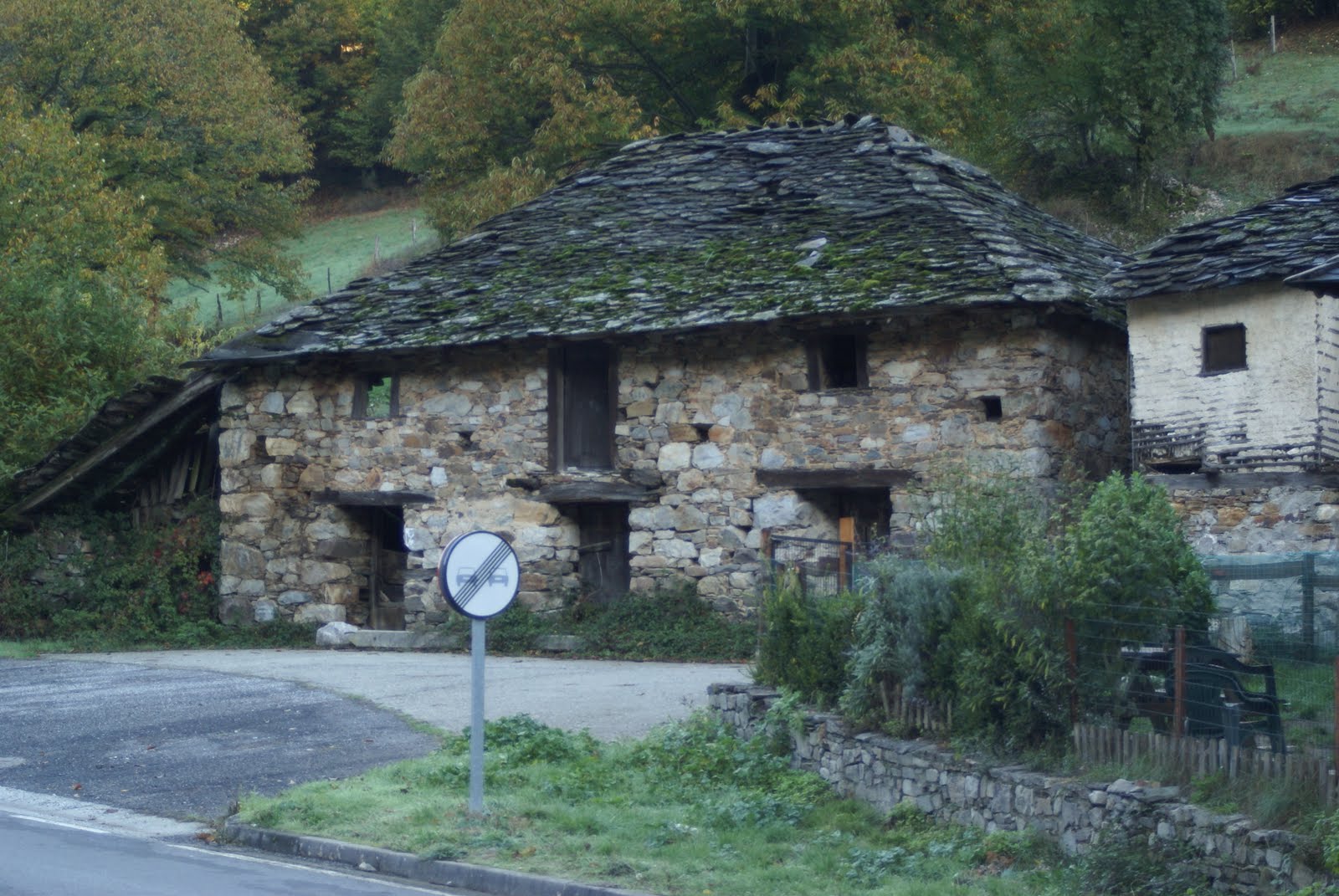
While I was visiting with Pablo and Jesus, Gretty and the boys explored Tineo, which seems to date from the 13th century. Perched on the side of the Narcea valley, it is a beautiful town and the people are very friendly. The empanadas are delicious! That evening we traveled to Vega del Horreo (an horreo is the small granary shown in the image above), a very small mountain village in La Cordillera de Cantabrica, where we stayed at the Hostel run by Ecotur (see link at right and image above). Really nice people run the hostel and business, but a good command of Spanish is essential if you plan to visit (mine has been improving drastically!).

Wanting to move to a drier climate, we then traveled over the mountains to the Principality of Castille-Leon where we found just what we were looking for - another closed campground that took us in for the night along Rio Luna (Moon River). Acequias (ditches) for irrigation, a large reservoir that innundated a number of rural villages, and fantastic geology and mountain scenery. Even had frost in the morning on our tents!

We're now in Salamanca after visiting Zamora (really cool plaza in the former, and cool castle in the latter) and will leave tomorrow for Toledo. I will meet with the technical officer of UNIPESCA in Madrid next week who also has his own business specializing in aquatic science and services. Looking forward to it.

Hasta Luego all! Dave.

Monday, October 25, 2010

On El Paseo De Hemingway!


We got out of France during the demonstrations! Our hearts are definitely with the demonstrators - Sarkozy is France's Bush - but it is nice to be able to go about the business and not get stuck in southern France without fuel, etc. It was actually quite benign in Pau, just outside of which one of the major French petro companies (Total) is based, but we did get to see Lycee (high school) students blockade their school for three days straight and have bonfires outside each chilly morning. Stayed away from the fish counter as the truckers were also on strike and the seafood was rotting in the stores.
We left following Hemingway through the Pyrenees to Auritz/Burguete (Basque/Spanish names) where he stayed after the rigors of Pamplona/Iruna bullfights and social scene in the 30s and from which he journeyed a few kilometres east to fish the Irati (which, along with the events in Pamplona/Iruna he immortalized in "The Sun Also Rises" - see the photo above). He is recognized in Auritz/Burguete with a plaque on the side of the Hotel in which he stayed, as well as in Pamplona/Iruna where his image and name appears all around the Plaza del Toros (bull ring) and on the Paseo de Hemingway (also see above).

Why consider Ernesto so important here? He did help bring recognition of Spain's fine trout fishing to America, and he is well regarded by the people in this region (as well as elsewhere, such as in Cuba). Anyway, have had some good success in making contacts and collecting information about the piscatorial landscapes here, and the travels continue. We're just outside Bilbao today after four days in Pamplona/Iruna. Staying near Mundaka, near Gernika-Luma from which many Basques leave to work in Oregon/Nevada/Idaho, we visited the penultimate market of the year w/ too much wine, cheese, bread, and other regional products to name and describe. We just fell into it. Lots of political activity too, and when a sticker was placed on the coat we had to remove it in fear of provoking the other side unknowingly (they were in Euskari or Basque language).

We are on to Asturias and Galicia, the remaining heart of Atlantic salmon in Spain, in a couple of days. The weather is warmer but wetter, so we may head to Andalusia to dry out for a while before resuming the Ruta de los Pesces.

All the best to you all, the Shive and the Aagaard-Shivelys.

Monday, October 18, 2010

Regions de France


Attn: Pics are in reverse order!

Leaving Basel, Switzerland on 10/5, we were immediately back in France. En route to the home of Rio's pen pal Eric near Dijon in Bourgogne, and his wonderful family, we passed through Belfort for lunch and haircuts. The city is a former historic (no redundancy - really) military center with a very impressive fort and battlements. Then we dallied down the Doubs valley exploring the villages and the river which is significantly modified for barging (a busy day). We spent several days in Bourgogne and were able to see the Cote d'Or (gold coast) while driving the Rue de Grand Crus (route of grand vineyards) in the heart of Burgundy w/ the leaves changing color (see photo!). This is a tourism must there. Classic and historic villages, vineyards, and beautiful autumn weather were all ours!

Several days then in Lyon - a great city that is even greater for its role in the French resistance during WWII. I visited with geographers from Lyon Universities 2 & 3 (and the Ecole Normal Superiere), we saw the old city, the Basilica de Notre Dame de Fourviere, the two Gallo-Roman ampitheatres, and visited the Musee de la Resistance et la Deportation. The last is an extremely important place to visit in Lyon we all think.

From Lyon it was on to Mende in the Massif Central which is in a landscape remarkably like Grants Pass in SW Oregon. We camped along the Riviere Lot. Next day we drove through the Gorge du Tarns (see photo!). Twelfth century chateaus and villages peppered along a gorgeous river that is now a popular tourism and recreation (say kayaks!) destination. We then saw the Viaduct du Millau that crosses the R. Tarns just below the terminus of the gorge. Camping that night was in a Ferme (farm) Camping area - pitched tents at 11 pm and woke to a beautiful landscape.

We're now in Pau at the foot of the Pyrenees (they're in sight!) for the research on the Piscatorial Landscape after doing a drive-by of Toulouse (unfortunately we had reservations to keep in Pau). It turns out that Gregory Dolet, a biologist and fishing guide here that I visited with, and Guillaume Baranco with Department 64) are working with other anglers and stakeholders to organize for the conservation of the fisheries and rivers - there is a big initiative under way here. You'll have to read the details in the book later. Anyway, for a fishing trip in the Pyrenes-Atlantique, a special area with Basque and Bearn influences, see Gregory's website at right and that of Peche64 (use Google to translate this if necessary).

The Pyrenees await - just have to find some gazole for the car so we can leave (the general strikes may limit fuel availability - another day of strike is scheduled for tomorrow after an especially volatile one today - see the BBC story here: http://www.bbc.co.uk/news/world-europe-11567457). C'est la vie! Au revoir, Dave et al.